
A Series A founder who sells five phone brands is really running five inventory businesses stitched together with duct tape, while the founder who runs one focused iPhone Mobile Shop is running one business that scales.

Multi-Brand Mobile Stores Bury Founders in Operational Debt
Apple Authorized Service Provider Program

Every extra brand a mobile retailer stocks adds a new supplier contract, a new repair-parts pipeline, a new warranty process, and a new set of staff training materials. A team running a general mobile store juggles Android variants, feature phones, and accessories built for a dozen different form factors. That sprawl consumes engineering hours, warehouse space, and support headcount that a founder could instead pour into growth.
An iPhone Mobile Shop removes that sprawl by design. One manufacturer means one firmware ecosystem, one repair toolkit, one accessory catalog, and one predictable release calendar. A founder building an iPhone Mobile Shop knows Apple’s product cadence months in advance, which turns inventory planning from guesswork into a forecasting exercise. Compare that to a multi-brand shop, where a founder tracks a dozen release schedules across competing manufacturers and still gets surprised by a sudden price cut or a discontinued model.
Operational debt shows up fastest in support tickets. A support team trained on iOS handles every device the same way: same settings menu, same backup process, same trade-in flow. A support team at a multi-brand store memorizes five different operating systems and still misses edge cases. Technical founders already know that fragmented systems produce fragmented outcomes — an iPhone Mobile Shop applies that same principle to retail operations instead of software architecture.
The inventory math reinforces the point. A multi-brand store holds safety stock across many SKUs with unpredictable demand curves, which ties up working capital in devices that might sit for months. An iPhone Mobile Shop concentrates that same capital into a narrower, higher-velocity SKU list, because Apple’s resale demand stays consistently strong across regions and price points. Concentrated capital moves faster, and faster-moving capital compounds.
The iPhone Mobile Shop Model Cuts Complexity, Not Ambition
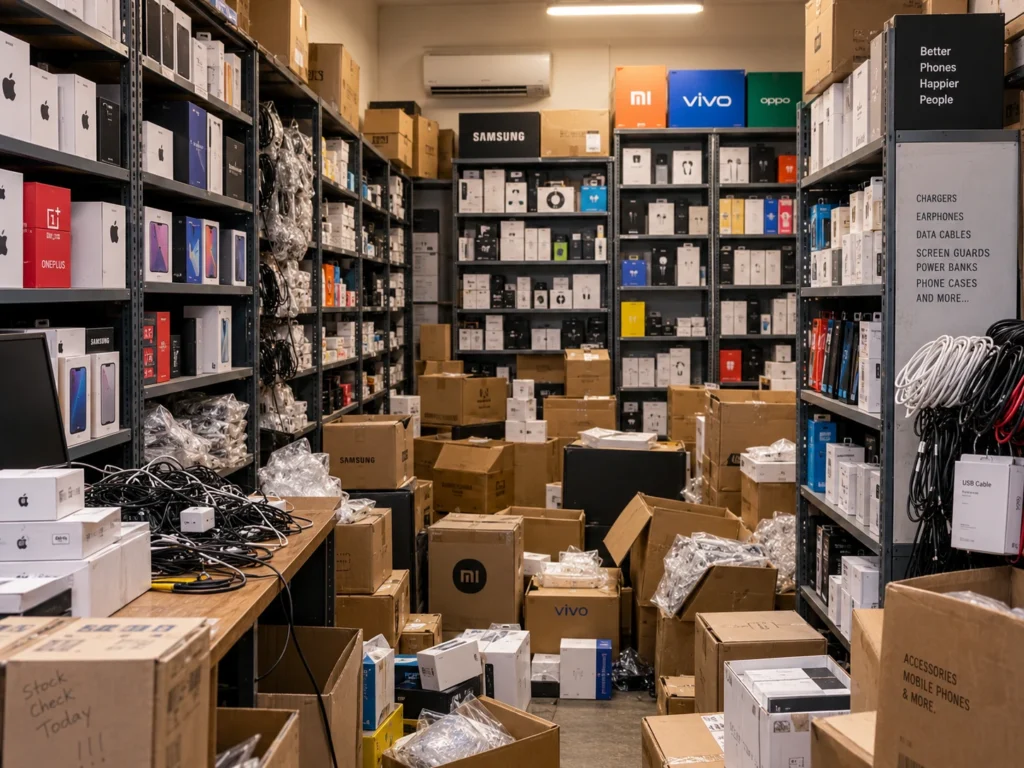
Founders sometimes assume that narrowing a product line means narrowing revenue. An iPhone Mobile Shop proves the opposite: focus expands the addressable revenue per customer instead of shrinking it. A buyer who walks into an iPhone Mobile Shop for a new handset also needs a case, a screen protector, a charging accessory, AppleCare-equivalent coverage, and eventually a trade-in slot for their next upgrade. Because every accessory in the store fits the same device family, the attach rate on add-ons climbs — the staff doesn’t need to ask which model or which port the customer owns.
This focus also simplifies the technology stack behind the store. A point-of-sale system built around a single ecosystem needs fewer integrations, fewer SKU mappings, and fewer exception cases in the checkout flow. A founder’s engineering team spends less time patching edge cases and more time shipping features that improve conversion: trade-in calculators, financing widgets, and repair-status trackers. An iPhone Mobile Shop, in other words, behaves like a well-architected codebase — narrow interface, predictable inputs, fewer bugs.
Repair economics follow the same logic. A repair bench stocked for one device family turns around screen and battery replacements faster because technicians specialize instead of context-switching between five different internal layouts. Faster repair turnaround increases store throughput, and higher throughput means more revenue per square foot without adding headcount. A founder evaluating unit economics should treat repair-bay throughput the same way they’d treat deployment frequency: a leading indicator of operational health.
Financing and trade-in programs also compress into a single, well-understood residual-value curve. Apple devices hold resale value more predictably than most competing brands, which lets an iPhone Mobile Shop offer trade-in credit with tighter margins and less risk. A multi-brand store has to model residual value separately for every manufacturer, which either forces conservative trade-in offers that frustrate customers or aggressive offers that erode margin. Neither outcome helps a founder trying to protect gross margin at scale.
Real Founders Choose Focus Because Focus Compounds Margin

Picture a founder who raised a Series A round to build a retail chain around refurbished and new devices. If that founder chooses a multi-brand strategy, the first twelve months go toward building supplier relationships across manufacturers, training staff on multiple diagnostic tools, and absorbing markdowns on slow-moving SKUs from brands with weaker resale demand. If that same founder chooses an iPhone Mobile Shop instead, the first twelve months go toward deepening one supplier relationship, mastering one diagnostic workflow, and building a loyal customer base that returns every upgrade cycle.
The compounding effect shows up in customer lifetime value. A customer who buys an iPhone from an iPhone Mobile Shop returns for accessories, repairs, and the next upgrade cycle roughly every two to three years, and every one of those touchpoints happens inside the same store because the ecosystem lock-in works in the retailer’s favor as much as Apple’s. A multi-brand store doesn’t get that same repeat-purchase gravity, because a customer who buys an Android phone one year might switch brands the next, taking their repeat business to a different retailer entirely.
Margin compounds through a second channel too: trade credit and supplier terms. A retailer that concentrates purchase volume with a single supplier chain earns better payment terms and volume discounts than a retailer spreading the same total spend across five smaller relationships. An iPhone Mobile Shop that scales its purchase volume negotiates from a position of concentrated leverage, and that leverage translates directly into gross margin improvement year over year.
Staff productivity compounds as well. A technician or salesperson who specializes in one device family becomes an expert faster than a generalist covering five ecosystems, and expertise shortens the sales cycle. A customer trusts a specialist’s recommendation more readily than a generalist’s, and shorter sales cycles mean more transactions per staff-hour. Founders optimizing for revenue per employee — a metric every Series A board asks about — get a direct lever to pull here.
Speed to Market Separates an iPhone Mobile Shop From Everything Else

Speed matters more than any other variable for a founder trying to hit Series A growth targets, and an iPhone Mobile Shop launches faster than a multi-brand alternative on every dimension that matters. Supplier onboarding takes less time because the founder negotiates one relationship instead of several. Staff training compresses into days instead of weeks because new hires learn one operating system, one repair process, and one accessory catalog. Store buildout simplifies because the fixtures, signage, and demo units all serve a single product family instead of competing for shelf space across brands.
Marketing spend also goes further inside an iPhone Mobile Shop, because the messaging stays consistent across every channel. A founder doesn’t split ad creative five ways to cover five brands; every dollar reinforces the same positioning, the same visual identity, and the same value proposition. That consistency shortens the time it takes paid acquisition channels to find their footing, which matters enormously for a founder watching burn rate against a runway clock.
Expansion follows the same accelerated path. Opening a second or third location for an iPhone Mobile Shop means replicating a playbook that a founder has already proven once, because the supplier relationship, the staff training program, and the store layout all transfer directly. A multi-brand store expanding to a new location has to re-negotiate multiple supplier terms for the new market and re-train staff across the same multi-brand complexity, which slows down exactly the kind of expansion that turns a Series A round into a Series B story.
Founders building toward a Series B raise need a growth story that a board can underwrite quickly, and “we replicate one proven store format” tells that story far more convincingly than “we manage five separate supply chains across five locations.” An iPhone Mobile Shop gives a founder a growth model that looks like software: modular, repeatable, and fast to deploy.
An iPhone Mobile Shop turns retail into a system a founder can actually scale, and that system beats a fragmented multi-brand store on every metric a Series A board checks first.
Written by roni19dgcreative.com