
A transport business turns physical throughput into recurring revenue faster than almost any software category a Series A founder can chase.

Why a Transport Business Beats Pure Software Bets
reduce empty miles by up to 64% through network optimization

Software margins look great on a slide, but they hide a brutal truth: most SaaS categories are crowded, sales cycles stretch past six months, and differentiation erodes within a year. A transport business skips that trap because it sells something a customer already budgets for every single month — moving freight, people, or packages from one point to another. You don’t need to convince a logistics manager that the problem exists; the problem already costs them money every day a truck sits idle or a route runs half-empty.
Technical founders bring an edge here that traditional trucking or delivery operators never had. Route optimization, dynamic pricing, telematics, and predictive maintenance are software problems layered on top of a physical asset business. A transport business built by an engineering-first team can extract margin that a legacy operator leaves on the table simply because the legacy operator never built the algorithms to find it. Uber Freight proved that matching engines could compress empty-mile percentages across a fragmented trucking market. Loadsmart proved that automated quoting could win freight brokerage deals in minutes instead of days. Neither company invented trucking. They applied software to an existing transport business and captured the spread.
The capital efficiency argument matters just as much. A transport business generates cash from day one of operation — a truck that runs a route earns revenue immediately, unlike a freemium app that needs eighteen months of iteration before anyone pays. Series A investors increasingly reward businesses with visible unit economics over businesses with growth curves built on promises. A transport business gives you a P&L statement that makes sense to a partner on day one of diligence, not a projection that requires three assumptions to believe.
The Unit Economics That Make a Transport Business Investable
the top ten U.S. carriers control just a fraction of the trucking market
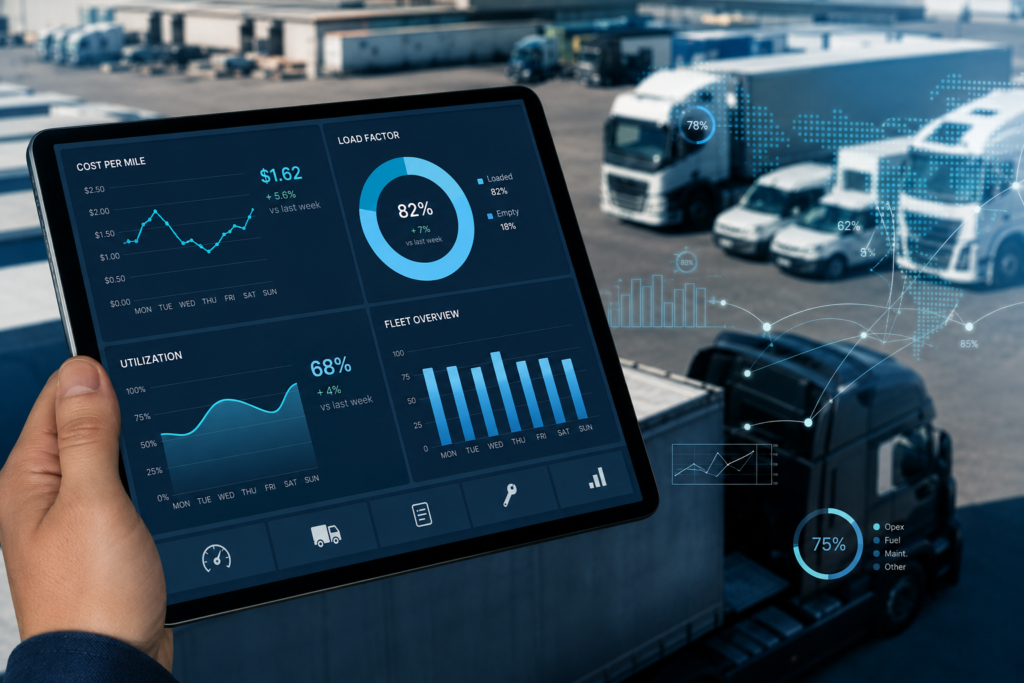
Investors evaluating a transport business look at four numbers before anything else: cost per mile, load factor, asset utilization, and contribution margin per route. Get these right and the rest of the pitch writes itself.
Cost per mile sets the floor. A transport business that owns its fleet needs to track fuel, driver pay, insurance, maintenance, and depreciation against every mile driven, then compare that number against the rate a customer pays per mile. The gap between those two figures is your gross margin, and it needs to widen as you scale, not stay flat. If your cost per mile doesn’t drop as fleet size grows, your transport business isn’t compounding — it’s just getting bigger at the same margin, which investors will notice immediately.
Load factor and asset utilization tell the growth story. An idle truck or an idle warehouse slot destroys margin faster than almost any other single input in a transport business. Founders who instrument every vehicle and every dock with real-time tracking can push utilization from the industry-typical 60-70% range toward 85% or higher, and that ten-to-twenty-point swing often determines whether the business is profitable or bleeding cash. This is exactly where a technical team wins: dispatch software, predictive demand modeling, and dynamic routing are the levers that raise utilization, and none of them require reinventing the vehicle itself.
Contribution margin per route is the number that convinces a Series A partner to write the check. It answers a simple question: does this specific lane, once fully loaded and running, throw off cash after direct costs? A transport business that can show ten profitable lanes and a repeatable playbook for finding an eleventh has something far more fundable than a business that shows aggregate revenue growth with no visibility into which routes actually make money. Flexport built its early credibility on exactly this kind of lane-level transparency, giving customers and investors a shared view of margin instead of a black box.
Real Examples: How Technical Founders Turned Transport Into Scalable Revenue
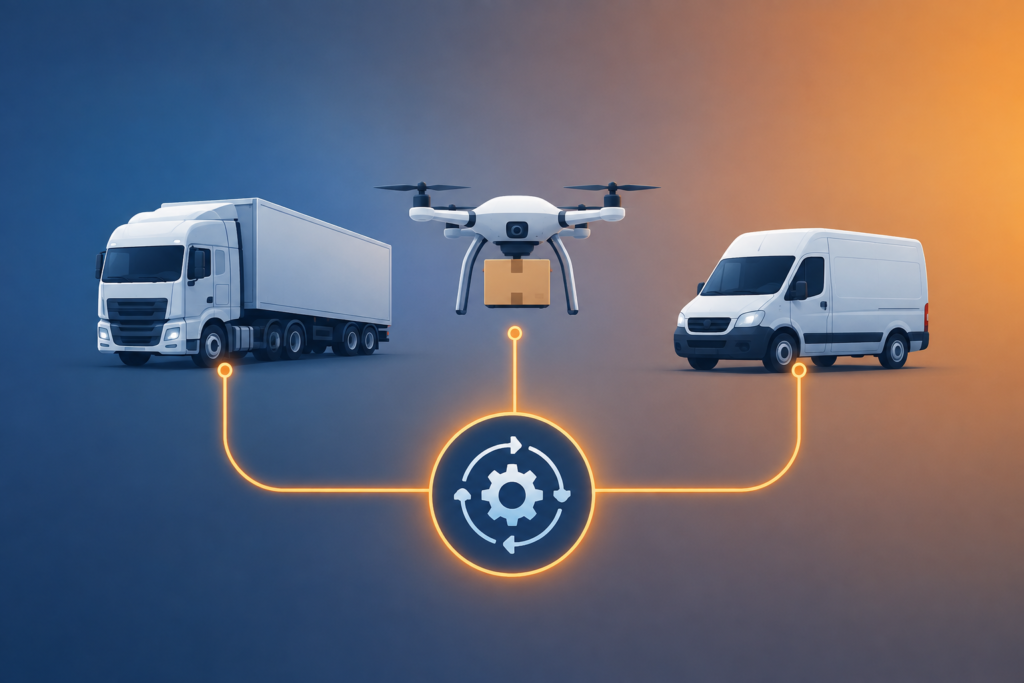
Convoy built a digital freight brokerage that matched shippers with truckers using an app instead of a phone call and a fax machine. The founding team came from Amazon and Bing, not trucking, and they applied search-ranking logic to freight matching — treating each available truck like a search result to be ranked against shipper demand. That software-first approach let a small team manage freight volume that would have required a much larger traditional brokerage staff.
Zipline took a different route inside the same transport business category: medical delivery by drone. Instead of optimizing an existing truck network, the founders built new physical infrastructure and layered flight-path software, inventory prediction, and weather-routing logic on top. The lesson for a technical founder isn’t “build drones” — it’s that a transport business doesn’t have to accept the existing vehicle or route as fixed. If the software makes a new physical approach viable, the transport business itself can look completely different from anything an incumbent runs.
Locus, the logistics optimization company out of India, took a narrower slice: last-mile delivery routing for retailers and couriers. Rather than owning trucks or drivers, the founders sold the optimization layer itself as a transport business input, pricing it against the fuel and labor savings it produced for customers who already ran fleets. This model shows a Series A founder doesn’t need to own physical assets to build a transport business — selling the intelligence layer to asset owners can produce software-grade margins on top of a transport-grade market.
Each of these companies shares a pattern a technical founder can copy directly: pick one narrow, measurable inefficiency inside an existing transport business — empty miles, idle drone capacity, unoptimized last-mile routes — and build the smallest possible software layer that captures the margin created by fixing it. None of them tried to fix the entire transport business at once, and that restraint is exactly what let them reach Series A with numbers instead of narrative.
The 90-Day Playbook to Prove Your Transport Business Model

Series A investors don’t fund ideas; they fund proof that a transport business model works at small scale and will keep working at larger scale. A 90-day plan built around three phases gives a technical founder that proof without burning the runway a seed round provides.
Days 1 through 30 focus on instrumentation. Before optimizing anything, wire every vehicle, route, or delivery node with tracking that captures cost per mile, cycle time, and utilization in real time. A transport business without data is a transport business guessing at its own margin. Founders who skip this step end up pitching investors with anecdotes instead of dashboards, and anecdotes don’t survive diligence.
Days 31 through 60 focus on one profitable lane. Pick the single route, corridor, or delivery zone with the highest theoretical margin based on the data collected in phase one, and push every resource toward making that lane fully profitable — not just revenue-positive, but margin-positive after driver pay, fuel, and overhead. A transport business that proves one lane works has a template. A transport business that spreads thin across ten unproven lanes has ten separate experiments and no proof of anything.
Days 61 through 90 focus on repeatability. Take the playbook that made lane one profitable and apply it to a second lane without rebuilding the entire operation from scratch. If the same dispatch logic, the same driver incentive structure, and the same customer acquisition motion produce a similar margin on lane two, the technical founder now has evidence that the transport business scales rather than just performs once. That repeatability, backed by real numbers from two independent lanes, is what turns a Series A conversation from a pitch into a term sheet discussion.
Throughout all three phases, resist the urge to add new vehicle types, new geographies, or new customer segments before the core lane economics prove out. A transport business earns permission to expand by proving the unit economics work in one narrow context first. Investors have seen too many founders chase breadth before depth, and a fragmented transport business with mediocre margins everywhere loses every time to a focused transport business with excellent margins somewhere specific.
Build the lane. Prove the margin. Then, and only then, build the next one — that discipline is what separates a transport business that reaches Series A from one that runs out of runway explaining a growth chart nobody can underwrite.
Written by roni19dgcreative.com