
Your engineering team ships in two-week sprints, but your marketing function still moves at the pace of a single overworked generalist — and that mismatch is quietly capping your growth curve.

The Hidden Cost of Building Marketing In-House Too Early
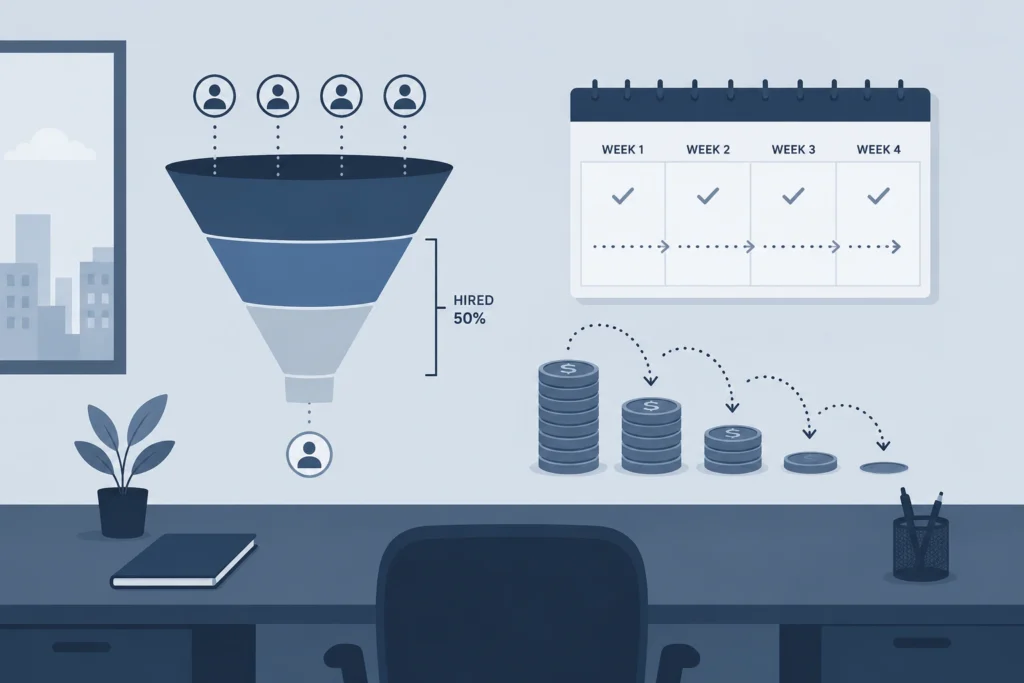
Founders who just closed a Series A tend to treat marketing the same way they treated their first backend hire: post a job, wait six weeks, onboard, ramp up. A digital marketing business doesn’t run on that timeline. It runs on retainers that start producing campaigns in days, not quarters.
Here’s the math most technical founders skip. A single in-house marketing hire costs salary plus benefits plus tooling plus the ramp time before they produce anything usable. Multiply that by the three or four specialists a real growth function needs — paid acquisition, content, lifecycle, analytics — and you’ve committed six figures before a single qualified lead shows up. A digital marketing business already owns that bench. You rent the capability instead of building it from zero, and you redirect your Series A capital toward product and engineering, where your technical team actually has an unfair advantage.
There’s also a skill-coverage problem that founders underestimate. One generalist marketer cannot simultaneously run paid search, write technical content that resonates with a developer audience, manage marketing automation, and interpret attribution data with any real depth. A digital marketing business brings that full stack on day one, because specialization is the entire premise of the model. You’re not betting your growth on one person’s strengths and blind spots.
Speed: How a Digital Marketing Business Compresses Your Time to Revenue

Series A companies live and die by their next milestone, usually a revenue number tied to the Series B raise. Speed isn’t a nice-to-have here — it’s the whole game. A digital marketing business compresses the distance between “we have a product” and “we have a repeatable pipeline” because it skips the parts that eat months: hiring, tool selection, channel testing from scratch.
Consider a typical B2B SaaS company at this stage. Building an in-house team means writing job descriptions, interviewing candidates, negotiating comp, and then watching a new hire spend their first month learning your product before they run a single campaign. A digital marketing business skips straight to execution because it has already built the playbooks for demand generation, SEO structure, and paid channel testing across dozens of prior engagements. It applies patterns that already work and adapts them to your market instead of discovering those patterns through trial and error on your budget.
Technical founders respect systems that compound, and a digital marketing business operates as a system rather than a single point of failure. If one channel underperforms, the team pivots budget within days because they’re running the same experiment across multiple portfolio clients simultaneously and can spot what’s working in adjacent markets. An in-house hire, by contrast, has one dataset: yours. They’re guessing in isolation while an external digital marketing business is pattern-matching across a much larger sample size.
Speed also shows up in reporting cadence. A mature digital marketing business ships weekly dashboards tied to pipeline, not vanity metrics like impressions or likes. Founders get a clear read on cost per qualified lead and cost per opportunity within the first month, which means bad bets get killed fast instead of limping along for two quarters while a junior in-house hire hopes the next campaign turns things around.
ROI: Why Outsourcing Beats Guessing With Your Own Team

ROI is the only metric that matters to a board evaluating your Series A burn rate, and this is where a digital marketing business separates itself most clearly from a scrappy internal team. The comparison isn’t “agency versus employee.” It’s “diversified expertise versus concentrated risk.”
A single in-house marketer represents a single point of failure. If they’re strong at content but weak at paid acquisition, your paid channels underperform for as long as they’re on your payroll, because you don’t have the budget to hire a specialist to cover that gap. A digital marketing business doesn’t have that constraint. It assigns a paid media specialist to paid media and a content strategist to content, so the weak link in a solo hire’s skill set simply isn’t part of the equation.
Cost structure reinforces this. Retainers with a digital marketing business scale with your budget and your stage, and you can adjust scope month to month as your priorities shift — heavier on paid acquisition before a fundraise, heavier on content and SEO once you need durable organic pipeline. An in-house team doesn’t flex that way. Severance, backfill time, and re-hiring costs make pivoting your internal marketing function slow and expensive, exactly when speed matters most.
There’s a compounding ROI argument too. A digital marketing business that’s worked with other Series A technical companies brings benchmark data you don’t have access to on your own — what a reasonable cost per opportunity looks like in your category, which channels saturate fastest for developer-tool audiences, where content actually drives pipeline versus where it just drives traffic. That benchmark knowledge shortens your learning curve and reduces the number of expensive experiments you have to run yourself before finding what works.
None of this means in-house marketing never makes sense. Once you’ve found your channel mix and your message-market fit, bringing a marketing leader in-house to own that proven system full-time is often the right next move. The point for a Series A founder is sequencing: use a digital marketing business to find the signal fast, then build the internal team around what’s already proven to convert.
Real Founders, Real Results: What Working With a Digital Marketing Business Looks Like

Strip away the theory and look at how this plays out operationally. A Series A founder brings a digital marketing business in with a specific, measurable goal — usually pipeline volume or cost per qualified opportunity, not brand awareness. The engagement starts with an audit: current channels, existing content, CRM data, past campaign performance if any exists. That audit alone often surfaces quick wins a solo in-house hire would take months to find, because an experienced digital marketing business has seen the same technical stack and the same buyer journey across other clients before.
From there, the team runs parallel tests across two or three channels instead of committing the whole budget to one bet. A technical founder recognizes this instinctively — it’s the same logic as running a feature flag experiment instead of shipping a single untested change to every user. Within four to six weeks, the data shows which channel produces qualified pipeline at a defensible cost, and budget shifts toward that channel while the underperformers get cut or reworked.
The reporting discipline matters as much as the execution. A capable digital marketing business ties every dollar spent back to a pipeline outcome your revenue team can defend in a board meeting, not a vague engagement score. That level of accountability is exactly what a founder needs when every dollar of Series A capital has to justify itself against runway.
What separates a strong engagement from a wasted one is founder involvement, not founder hand-holding. The best outcomes happen when a founder gives a digital marketing business direct access to product context, customer interviews, and honest data about what’s actually converting in sales conversations. Treat the relationship as an extension of your team with deep specialist coverage, not a vendor you check in with once a month, and the speed and ROI advantages compound instead of flattening out after the first quarter.
Choosing a digital marketing business at Series A isn’t outsourcing for its own sake — it’s buying speed, specialist depth, and defensible ROI you can’t yet build in-house, then using what you learn to hire smarter later. Skip the six-month ramp, rent the expertise, and spend your capital proving your product deserves a Series B.
Written by roni19dgcreative.com
Resource :- ROI: Why Outsourcing Beats Guessing